
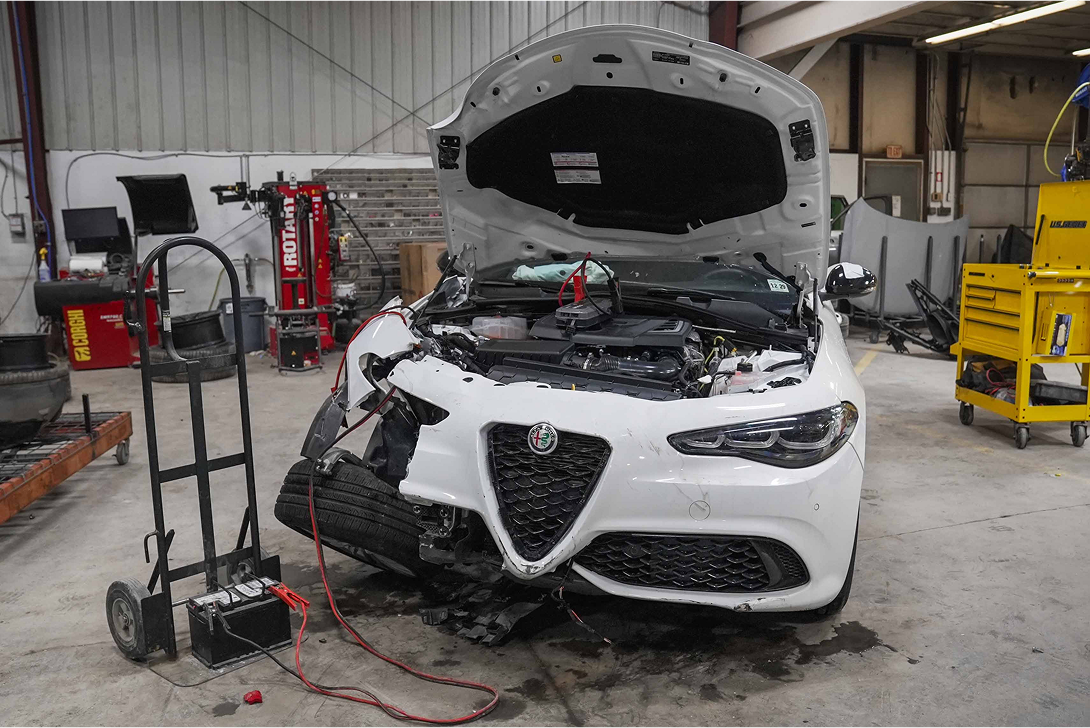
5 Car Parts You Should Always Buy Used
Used auto parts aren't a compromise. For five specific components,...
A connecting rod bearing that’s on its way out gives you warning, usually a deep and rhythmic thump at idle that intensifies under acceleration and is easy to rationalize away for a week or two. Then one morning the connecting rod breaks free from the crankshaft, swings through its arc at combustion velocity, and punches a hole clean through the side of the block, a failure mechanics call throwing a rod. What that means in practical terms is that a repairable bearing problem has just become a scrap-metal problem.
Those are the stakes with any engine knocking noise originating from the bottom end, where the interval separating “still driveable” from “the block is now a boat anchor” is measured in days and occasionally in miles. This guide covers how to identify what you’re hearing, how to confirm the diagnosis with three tests you can perform in your own driveway, and how to determine whether you’re facing an inexpensive repair or a complete engine replacement.
Read the sound-identification section first, and if it points to bottom-end knock, stop driving the car before you finish the rest of the article.
Not every engine knocking noise signals catastrophe, but the fatal ones share a consistent signature: a deep, metallic, rhythmic thump originating low in the engine that keeps time with engine speed and grows louder under load, which is the specific sound that ends engines. A higher-frequency tick from the top of the motor, or a rattle that surfaces only under hard acceleration, typically points to something considerably less severe.
Getting this distinction right in the first thirty seconds is what stands between a straightforward bearing job and a complete engine replacement, so here’s how the three most common noises separate from one another.
Rod knock (deep thumping). Heavy, metallic, and rhythmic, it synchronizes with engine speed and quickens as you rev, and it frequently presents at its worst on a cold start before oil pressure has fully built. This is the bottom end, where failed connecting rod bearings have opened enough clearance that the rod hammers the crankshaft journal in direct metal-to-metal contact. This is the failure that throws a rod.
Valvetrain tick (high-pitched clicking). Lighter and faster than rod knock, and emanating from the top of the engine near the valve cover, this noise follows engine speed but does not intensify under load the way a bottom-end knock does. The usual culprits are a hydraulic lifter starved of oil pressure, a valve lash adjustment that has drifted out of specification, or a collapsed lifter. Irritating, but rarely fatal on its own.
Spark knock, also called detonation or ping. A metallic rattle resembling marbles in a can, appearing only during acceleration or when the engine is lugging up a grade, this noise isn’t mechanical wear at all but rather the air-fuel mixture igniting unevenly, driven by incorrect ignition timing, low-octane fuel, accumulated combustion-chamber carbon, or a failed knock sensor.
One of these three matters enormously while the other two are merely inconvenient, so if you’re hearing that deep bottom-end thump, that’s your signal to pull over.
Shut the engine down and don’t restart it if the deep knock is accompanied by any of these: the oil pressure warning light, a visible drop on a mechanical oil pressure gauge, or the knock getting progressively worse over minutes rather than staying steady. Every rotation of a spinning bearing at that point is grinding away crankshaft material and pushing you from a bearing repair toward a block replacement.
A rod driven through the oil pan or block casing is categorically not repairable, and it represents the single most expensive way to learn this lesson despite being entirely preventable by shutting the engine down at the first confirmed bottom-end knock. Continued operation is precisely what converts a rebuildable core into scrap metal.
The location and behavior of the sound tell you almost everything before you pick up a tool. Rod knock lives at the bottom of the engine, tracks engine speed, and worsens measurably under load, while valvetrain noise lives at the top, tracks engine speed, but stays roughly even regardless of load. Spark knock appears only under acceleration and vanishes entirely at steady cruise.
There’s a fourth noise worth cataloguing because it convincingly mimics rod knock: main bearing knock. It presents as deeper and more resonant, you frequently perceive it as a vibration transmitted through the chassis rather than a discrete audible knock, and it varies comparatively little with engine load. Like rod knock, it is a bottom-end lubrication failure that terminates in the same catastrophic place. A heavy thud felt through the seat rather than heard through the firewall deserves identical urgency.
Piston slap belongs in this diagnostic group as well. That same piston-to-bore clearance discussed above produces a characteristically hollow knock, typically most pronounced on a cold engine and diminishing as thermal expansion brings the piston into closer tolerance with the cylinder wall. On certain high-mileage engines it remains a tolerable nuisance for years. On others it represents the leading indicator of accelerating internal wear.
Bottom-end knock almost always traces to one underlying root cause: the hydrodynamic oil film that’s supposed to keep metal off metal has broken down. Connecting rod bearings ride on a pressurized film of oil only a few thousandths of an inch thick, so interrupting that film allows the bearing to wear, the clearance to open, and the knock to begin. Understanding the three distinct failure paths is what tells you whether the remainder of the engine is worth salvaging.
Oil starvation. The most common precipitating cause. A low oil level, a failing oil pump that can no longer sustain adequate pressure, or clogged oil galleries that choke off flow to the connecting rod journals will all interrupt the hydrodynamic wedge that keeps the bearing surfaces separated. Because that same pressurized oil film simultaneously lubricates the bearing and dissipates the considerable frictional heat generated at the journal interface, oil starvation eliminates both functions at once, which is precisely why it destroys bearing material with such speed.
Spun rod bearing. When a bearing overheats sufficiently to gall and momentarily weld itself to the crankshaft journal, then tears loose under rotational load, it spins within the connecting rod bore. Once displaced, the bearing shell occludes its own oil feed hole, which guarantees total lubrication loss to that rod and accelerates the metallurgical damage to the crankshaft journal itself. The spun bearing is the failure threshold at which the crankshaft typically sustains scoring, and crankshaft damage of that nature is what pushes many engines past the economic viability of a targeted repair.
Worn wrist pins and piston slap. Excessive clearance between the piston skirt and cylinder wall, or in the wrist pin that articulates the piston against the small end of the connecting rod, produces a knock generated by components that should maintain interference-close tolerances instead moving freely. This is progressive wear failure, the variety that manifests on engines carrying high accumulated mileage or a documented history of deferred oil-change maintenance.
Here’s the pattern worth internalizing: contaminated oil produced by any one of these failures actively accelerates the others, because metal shed by a wearing bearing circulates through the entire lubrication system, scoring the remaining bearings and the cylinder walls as it goes. A single localized failure rarely remains a single failure for long, which is one substantial reason a complete used engine assembly frequently makes more sense than chasing one bad bearing through a partial teardown.
You can confirm bottom-end failure in your own driveway with three tests and roughly an hour, without any engine teardown required. Run them in the order given, because each one progressively narrows the diagnosis, and taken together they’ll tell you with high confidence whether you’re facing a top-end fix or a bottom-end replacement.
One caveat from the field: not every lower-end knock is a rod. Documented teardowns have found cracked piston crowns and even loose debris in the oil pan producing rhythmic knocks that fooled experienced techs. Use all three tests together rather than trusting any one in isolation, and never rely on the dashboard oil light alone. A mechanical gauge on the block’s sender port tells the truth the dash light won’t. For a deeper walkthrough of bearing failure modes, the technical breakdown from Highway and Heavy Parts on connecting rod failure covers the metallurgy in useful detail.
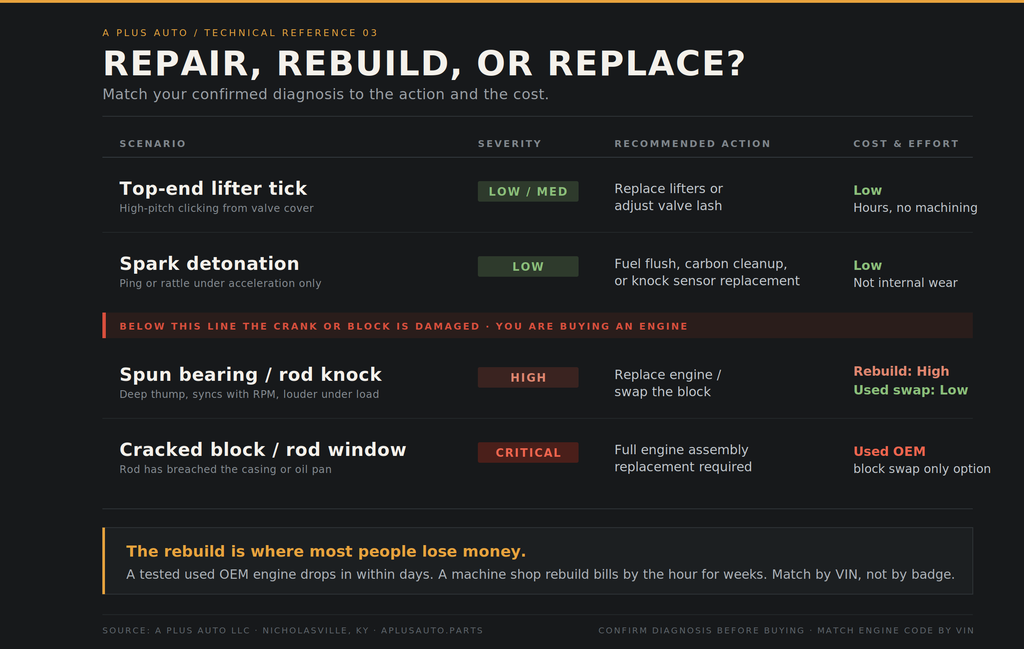
The right call hinges on a single question: is the damage confined to soft, replaceable components, or has it propagated into the crankshaft and block? Top-end problems and detonation are inexpensive to remedy, whereas a spun bearing that has scored the crank journal, or a rod that has breached the block casing, commits you to replacing the entire assembly. This is the decision matrix that separates the two paths.
[INSERT INFOGRAPHIC HERE: engine-knock-decision-matrix-infographic.svg] Alt text: Engine knocking noise decision matrix comparing severity, recommended action, and cost for lifter tick, spark detonation, rod knock, and cracked block Caption: Match your confirmed diagnosis to the action. Anything below the red line is a block replacement conversation.
The line that changes everything is the transition from a lifter tick to a spun bearing. Below that threshold you’re adjusting valves or flushing fuel for a few hundred dollars, whereas above it, once the crankshaft is scored or the block is cracked, you’re committed to buying an engine. The middle ground of a full rebuild is where most people lose money, and the next section explains the economics behind that.
For most out-of-warranty vehicles, a tested used OEM engine outperforms a custom machine shop rebuild across the three variables that actually matter: turnaround, total expenditure, and outcome predictability. A rebuild entails complete disassembly of the failed engine, dispatching the block and crankshaft to a machinist for boring, honing, and align-work, then waiting on that shop’s production queue while every operation accrues billable labor. A used assembly, by contrast, is a single tested unit that installs as a complete component.
The math tends to break down like this:
The rebuild path makes sense in narrow cases: a rare engine with no used supply, a numbers-matching classic, or a build where you want specific upgraded internals. For a daily driver with a spun bearing, those don’t apply.
The one step you cannot skip is fitment verification. Engines interchange according to year, make, model, and frequently a specific engine series and VIN identifier, rather than by the nameplate on the trunk lid. A single model year commonly offered more than one powerplant, and the incorrect assembly either will not physically bolt to the transmission and mounts or will fail to communicate correctly with the vehicle’s engine control unit. Matching the engine code against your application and confirming VIN interchange before purchase is the discriminating step that separates a clean installation from a costly return.
If your diagnosis lands below the red line on that matrix, a bearing job or valve adjustment is your path and you don’t need us for it, but if it lands above the line, you need a replacement engine that fits correctly the first time.
Every used engine and short block in our inventory is inspected and tested before it’s listed, photographed off the vehicle, and backed by a 1-year warranty with 2- and 3-year upgrade options. You can search our used engine and parts inventoryby year, make, and model to find a matched assembly, and our team verifies compatibility against your VIN so the engine series and interchange are correct before anything ships.
Call us at +1 859-421-3043 with your VIN and the engine code you’re replacing, and we’ll confirm the match with you before you commit. A Plus Auto is at 2125 Catnip Hill Rd in Nicholasville, KY 40356, serving Lexington, Jessamine County, and shipping nationwide within one business day.
Confirm the knock. Match the VIN. Skip the machine shop wait.
Engine knock diagnosis involves working around a running engine and hot components. If you’re not confident running these tests safely, have a qualified mechanic confirm the diagnosis before you make a repair-or-replace decision.
Used auto parts aren't a compromise. For five specific components,...

When a dealer says the interior part is discontinued, the...
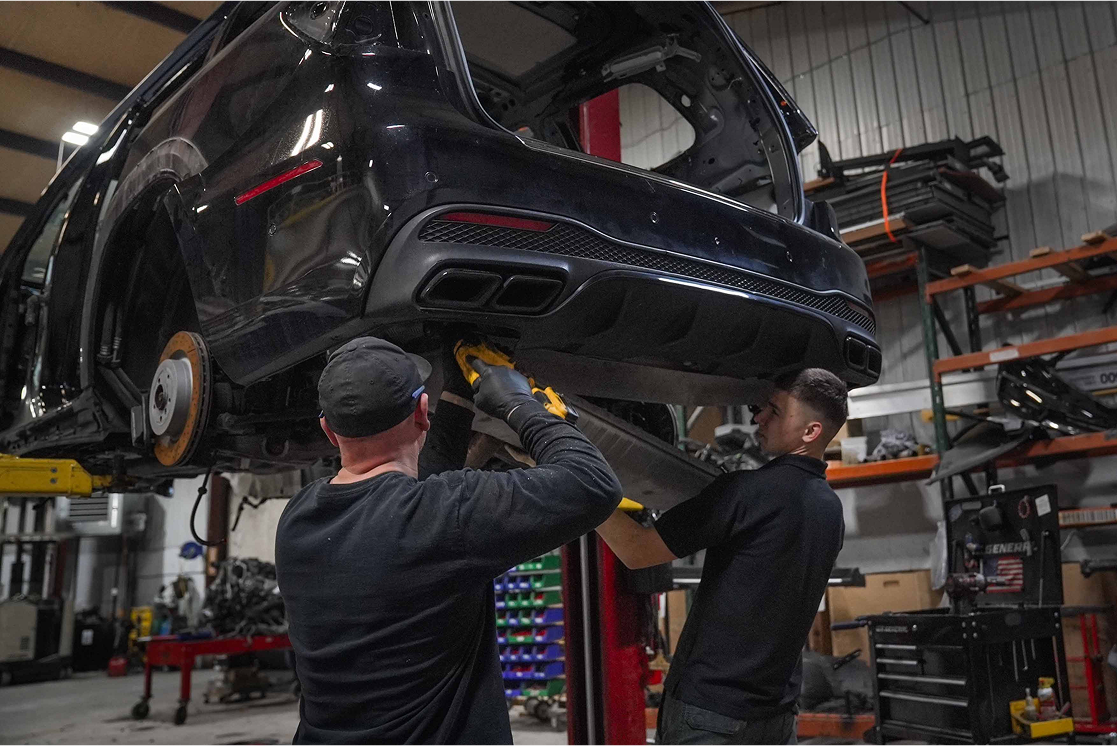
A cheaper aftermarket panel often costs more once you pay...
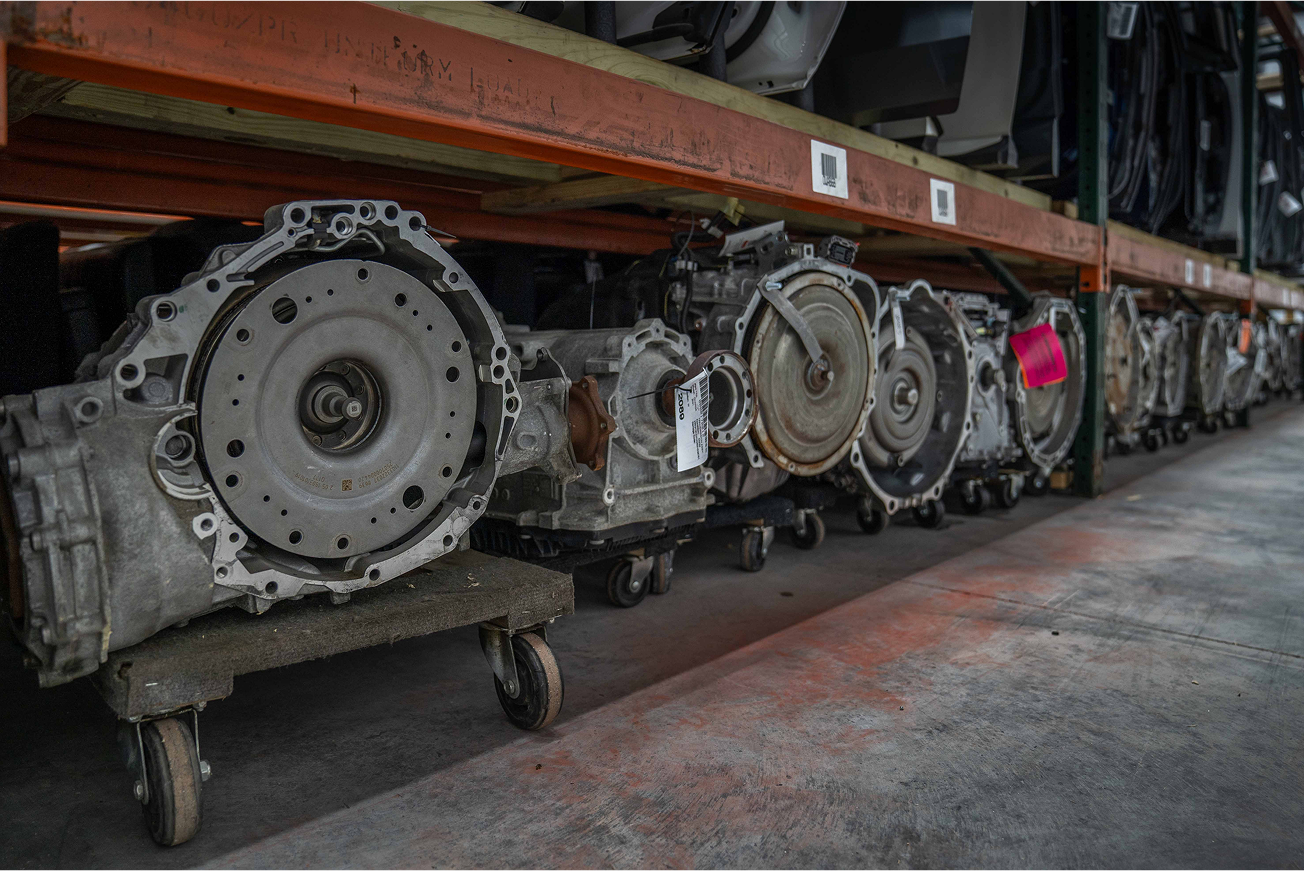
Engine knocking noise decoded: tell rod knock from valve tick,...