

Car Sagging on One Side? How to Diagnose an Air Suspension Leak
If your car sits level all day but sags on...
A customer calls asking for a headlight assembly for his 2017 GLS 450, having already purchased one that arrived off a 2015 GL 450, and the seller who sold it to him insisted the chassis designation was identical. Technically, that seller was correct. The part still doesn’t fit.
That particular call arrives more frequently than any other inquiry on this platform, which is precisely why this Mercedes GLS used parts guide begins with chassis codes rather than part numbers. Mercedes renamed the GL to the GLS partway through a single uninterrupted production run, meaning the vehicle retained the same assembly plant, the same floorpan, and the same 121.1-inch wheelbase while simultaneously receiving a different badge, a different front bumper, a different headlight cluster, and a different infotainment head unit. Shop by model designation alone and you will eventually order a component that bolts to nothing.
What follows is what each chassis generation actually consists of, where the fitment discontinuities fall within and between those generations, and how to verify precisely what you’re looking at before any money changes hands.
Your Mercedes GLS is one of three chassis: X164 (2007 to 2012, badged GL-Class), X166 (2013 to 2019, badged GL through 2016 and GLS from 2017), or X167 (2020 to present, badged GLS throughout). The chassis code, not the badge on the tailgate, determines what interchanges.
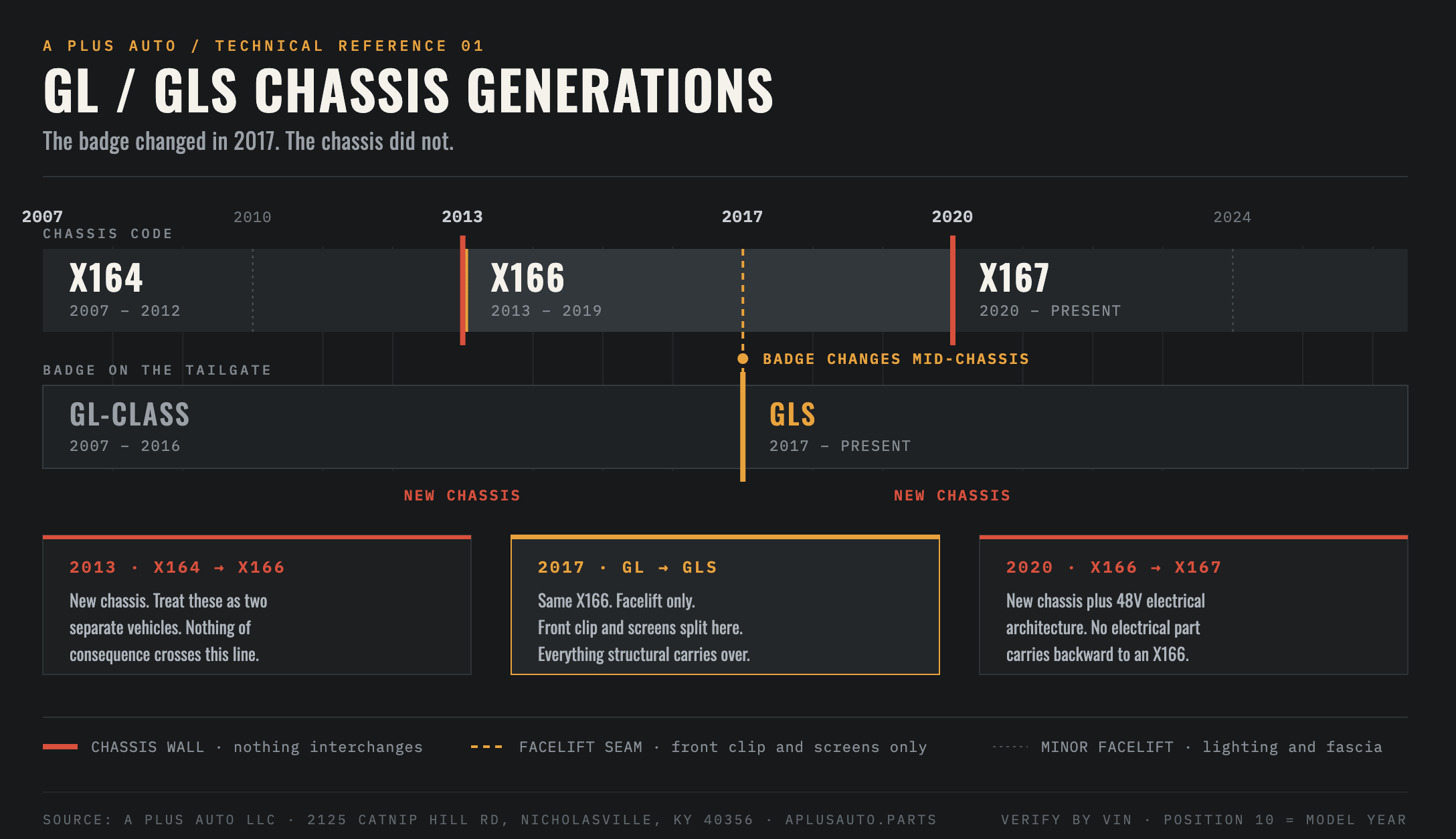
Model year alone won’t resolve the question either, because the 2016-to-2017 transition amounts to a nomenclature change layered onto a structurally unchanged platform, whereas the 2019-to-2020 transition represents a genuinely new vehicle developed on a separate architecture. One of those boundaries carries enormous consequences for parts sourcing. The other matters considerably less than buyers assume, though not nearly as little as the sellers moving inventory across it tend to claim.
Three generations, then, separated by two fundamentally different categories of boundary.
The X164 GL-Class was built at the Mercedes-Benz plant in Tuscaloosa, Alabama, and ran from model year 2007 through 2012 in North America. It shared its bones with the contemporary M-Class, which is worth knowing because it widens your donor pool on a handful of components.
Powertrains were straightforward by later standards. The GL 450 carried the M273 4.7-liter naturally aspirated V8, the GL 550 got the 5.5-liter displacement variant of that same M273 family, and the diesel side ran the OM642 3.0-liter turbocharged V6 under two designations: GL 320 CDI through 2009, then GL 350 BlueTEC from 2010 once selective catalytic reduction and diesel exhaust fluid dosing entered the emissions package. Every X164 used the 7G-Tronic seven-speed automatic, internally designated the 722.9.
The 2010 model year brought a facelift. It was mild by Mercedes standards, adding roughly half an inch of overall length alongside revised front-end sheet metal and lamp graphics, which means front bumper covers and lighting assemblies split at that point even within the X164 designation.
Practical note for anyone dismantling or sourcing from this generation: M273 timing chain tensioner wear is a documented failure mode that accelerates past roughly 90,000 miles, and OM642 injector seal degradation is equally well established across the diesel range, driven partly by biodiesel content attacking the original seal compound. Both determine what you inspect on a used engine before it goes on a pallet, and both are reasons to buy from a yard that photographs the actual unit rather than assigning a grade from a spreadsheet.
The X166 is where this becomes genuinely consequential, and it’s the origin point for most Mercedes GLS used parts confusion in circulation.
Production ran from June 2012 to April 2019, spanning model years 2013 through 2019, out of the MBUSI facility in Vance, Alabama. For model years 2013 through 2016, Mercedes marketed the vehicle as the GL-Class, and from 2017 through 2019 that identical vehicle was marketed as the GLS, because Mercedes wanted its largest sport-utility offering positioned beneath the S-Class within a rationalized naming hierarchy that the marketing department summarized as “the S-Class of SUVs.”
Nothing structural changed. Wheelbase remained at 121.1 inches and width remained at 76.1 inches, while overall length increased by roughly two-tenths of an inch, from 201.8 to 202.0, a figure that quantifies with unusual precision exactly how little of the vehicle was actually redesigned.
Engines across the X166 run included the M276 3.0-liter twin-turbo V6, the M278 4.7-liter twin-turbo V8, the M157 5.5-liter twin-turbo V8 in the AMG models, and the OM642 3.0-liter diesel carried over from the X164.
This is the section to read twice.
The 2017 rename came bundled with a mid-cycle facelift, and the facelift touched a specific and predictable list of components. Everything on this list splits at the 2016/2017 boundary even though the chassis code does not:
Notice what is absent from that list: doors, fenders, tailgate, roof, glazing, rear suspension geometry, Airmatic components, third-row seat assemblies, and the transfer case. The entire structural and mechanical core of the vehicle carried through the rename completely untouched, which is the opposite of what the badge change implies to anyone shopping by model name.
That asymmetry between cosmetic revision and structural continuity is the single most commercially useful fact in this guide. The facelift is skin and screens. The chassis is the chassis.
Yes, for most of the vehicle, and no for the front clip and infotainment. A 2013 GL 450 and a 2019 GLS 550 share an identical X166 platform, which means structural body panels, glazing, suspension hardware, and interior architecture cross over without modification. The parts that don’t cross are precisely the ones the 2017 facelift redesigned: headlights, front bumper, grille, COMAND unit, instrument cluster, and the seven-speed versus nine-speed transmission split.
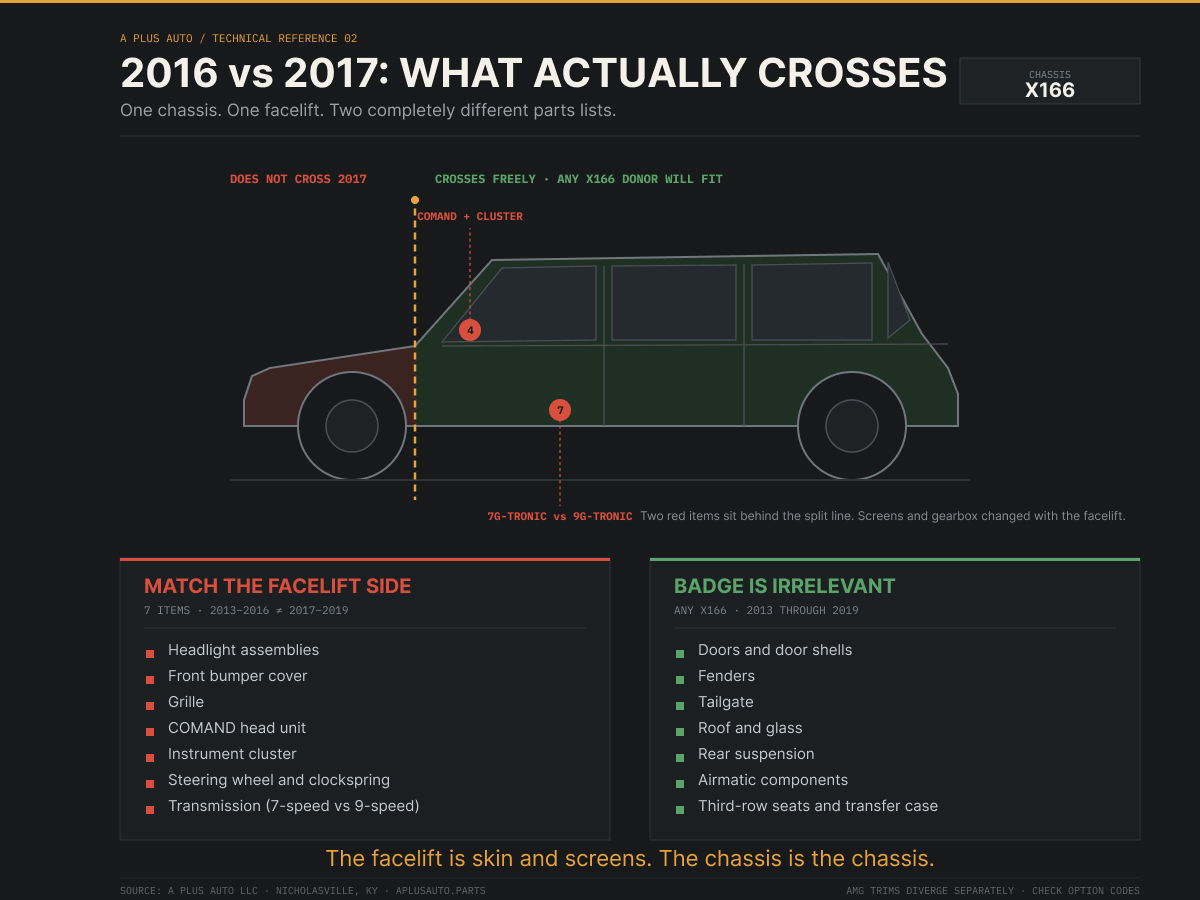
Ask yourself what you’re actually buying. If it’s a rear door shell, a set of Airmatic struts, a transfer case, or a third-row seat assembly, the badge on the donor vehicle is irrelevant and any X166 will serve. If it’s anything visible from directly in front of the vehicle, or anything with a display embedded in it, you need to match the facelift side of the boundary.
Trim complicates this further, and it cuts perpendicular to the facelift question rather than parallel to it. The GLS 450 and GLS 550 share a substantial percentage of their component inventory. AMG variants share dramatically less than most buyers anticipate, because the AMG-specific fascias, braking hardware, suspension calibration, and the M157 powertrain diverge from the standard range at nearly every mechanical interface, and that divergence holds regardless of which model year you’re comparing.
The X167 replaced the X166 for model year 2020, and this is a real generational change rather than a rebadge. It’s longer, it’s wider, and it moved to a fundamentally different electrical architecture.
Powertrains changed completely. The GLS 450 abandoned the V6 configuration for the M256 3.0-liter inline-six paired with a 48-volt EQ Boost mild hybrid system, while the GLS 580 runs the M177 4.0-liter twin-turbo V8 with comparable 48-volt integration. Above them sit the Maybach GLS 600 and the AMG GLS 63. That 48-volt architecture is not a footnote. Because the integrated starter-generator replaces the conventional alternator and belt-driven accessories, the wiring harness topology, the accessory drive, and the entire diagnostic methodology shift, which means essentially nothing electrical carries backward from an X167 donor to an X166 recipient.
The X167 has its own internal split, too. Mercedes facelifted it in April 2023 for the 2024 model year, adding a larger four-louvre grille, revised LED taillight graphics, new exterior colors, and updated MBUX display options. Same story as 2017, smaller scale.
Worth knowing before you buy any X167 component: in March 2024 Mercedes recalled more than 116,000 GLE and GLS vehicles built between 2019 and 2024 over a 48-volt ground cable under the front passenger seat that may not have been torqued correctly. You can check any specific VIN against open recalls through the NHTSA recall lookup tool, which is free and takes about thirty seconds. Do it before you buy a donor part, and do it before you sell one.
Decode the VIN. Position 10 encodes the model year, and that single character resolves the chassis question more definitively than any conversation with a seller who has inventory to move.
Take a vehicle currently sitting in our Nicholasville yard as a worked example. Stock 2752 is a 2017 GLS carrying VIN 4JGDF6EE4HA769674, in which the leading 4JG identifies Mercedes-Benz US International in Alabama as the manufacturing origin. Count across to the tenth character and you find an H, which decodes to model year 2017. That single character establishes the following simultaneously: X166 chassis, post-facelift side of the boundary, 9G-Tronic nine-speed transmission, facelift-specification headlight clusters, and the free-standing COMAND architecture. Every material fitment question about that donor vehicle is resolved before anyone picks up a telephone.
Then check the option codes. Mercedes configuration variance within a single model year is substantial, and the code sticker in the spare tire well or beneath the trunk liner enumerates every factory-fitted option on that specific build. Two 2018 GLS 550s leaving Vance on the same day can carry different headlight technology, different suspension calibration, and different infotainment hardware depending entirely on how the original order was specified. Trim level tells you less than the codes do.
A short checklist that catches the majority of returns before they happen:
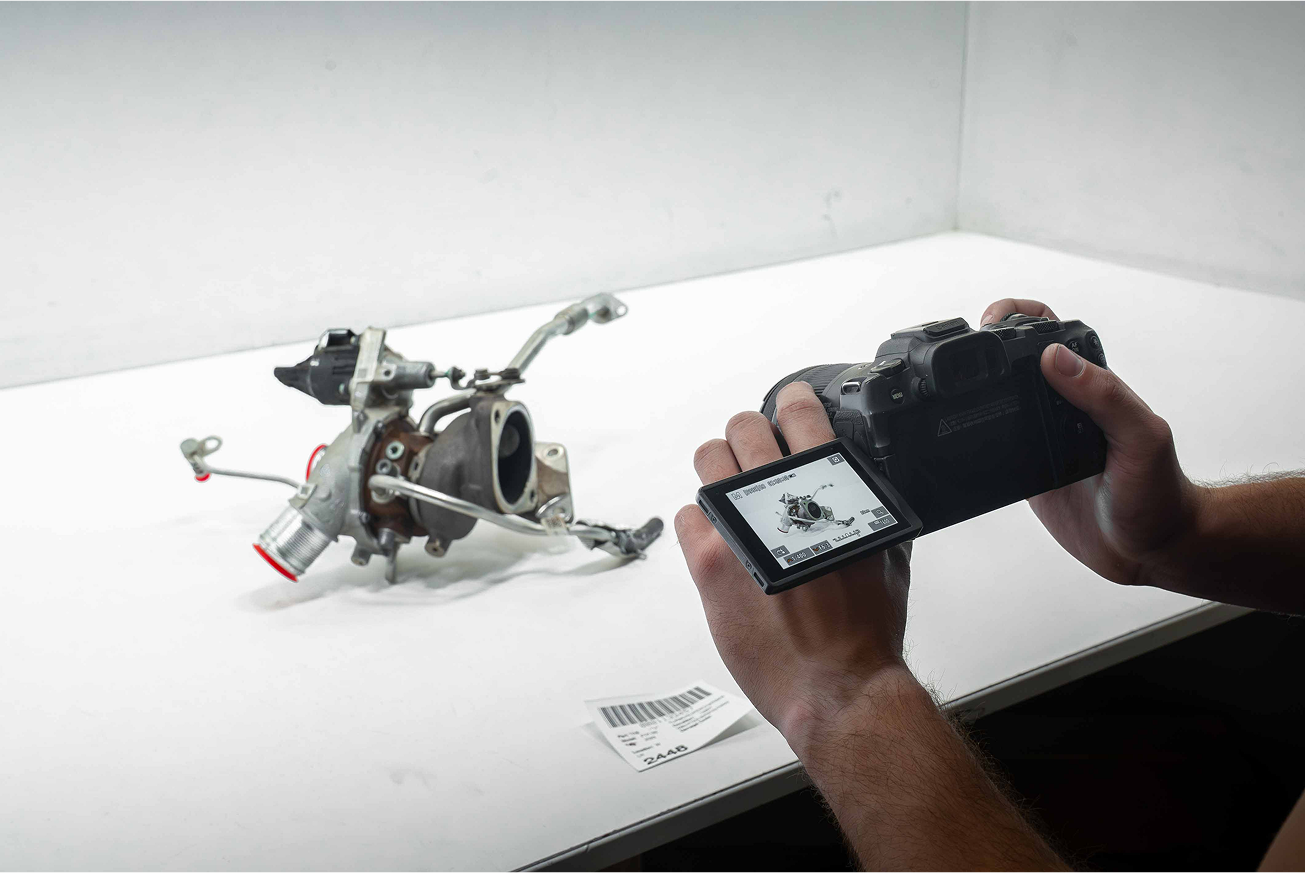
That last point is where we differ from most yards, and it’s deliberate. Every part we pull is dismantled first, cleaned, then photographed off the vehicle before it goes into inventory. When you’re spending real money on an Airmatic compressor or a COMAND head unit, seeing the exact part beats trusting a grade code.
Used original equipment outperforms aftermarket reproduction on a vehicle in this segment, and the margin isn’t close. Mercedes manufacturing tolerances on body panels, lighting assemblies, and electronic modules are tight enough that aftermarket reproductions routinely fight the installer on panel gap and alignment, while the dealer counter price on genuinely new OEM inventory makes the economics untenable for any vehicle past its factory warranty period. A properly dismantled OEM component sourced from a chassis-matched donor is the identical part the factory installed, at a fraction of that counter price.
The chassis code is the whole game. Get that right and the rest follows.
Our used Mercedes GLS parts inventory is searchable by year, and because the 2013 to 2016 cars are catalogued separately, our GL-Class inventory is worth checking in parallel whenever you’re after a structural or mechanical component that crosses the rename. You can also browse the full used Mercedes auto parts catalog across every model we stock.
Every part ships with a 1-year warranty, leaves the warehouse within one business day, and gets photographed before it’s listed. If you’re not certain which chassis you’re working with, call us at +1 859-421-3043 with your VIN and we’ll decode it with you. A Plus Auto is at 2125 Catnip Hill Rd in Nicholasville, KY 40356, serving Lexington, Jessamine County, and shipping nationwide.
Send the VIN. Skip the guesswork.
If your car sits level all day but sags on...
Pressing new bushings into an old arm seems cheaper until...

Four sensor codes at once rarely means four bad sensors....
Some replacement modules drop right in. Others won’t work until...