

Buying a Used Toyota Tacoma Engine: A Complete Guide
A practical guide to buying a used Toyota Tacoma engine,...
Pop the hood on a modern Civic or CR-V and you won’t find gears turning the way they did in your dad’s Accord. Honda CVT transmission vs automatic transmission is one of the most searched comparisons among Honda owners, and for good reason. The two systems get power from the engine to the wheels in fundamentally different ways, and that difference shows up in how the car feels, how it drives, and eventually, how much a repair bill might cost.
This isn’t a sales pitch for one over the other. It’s a plain look at how each transmission works, where each one tends to fail, and what a Honda owner should actually watch for.
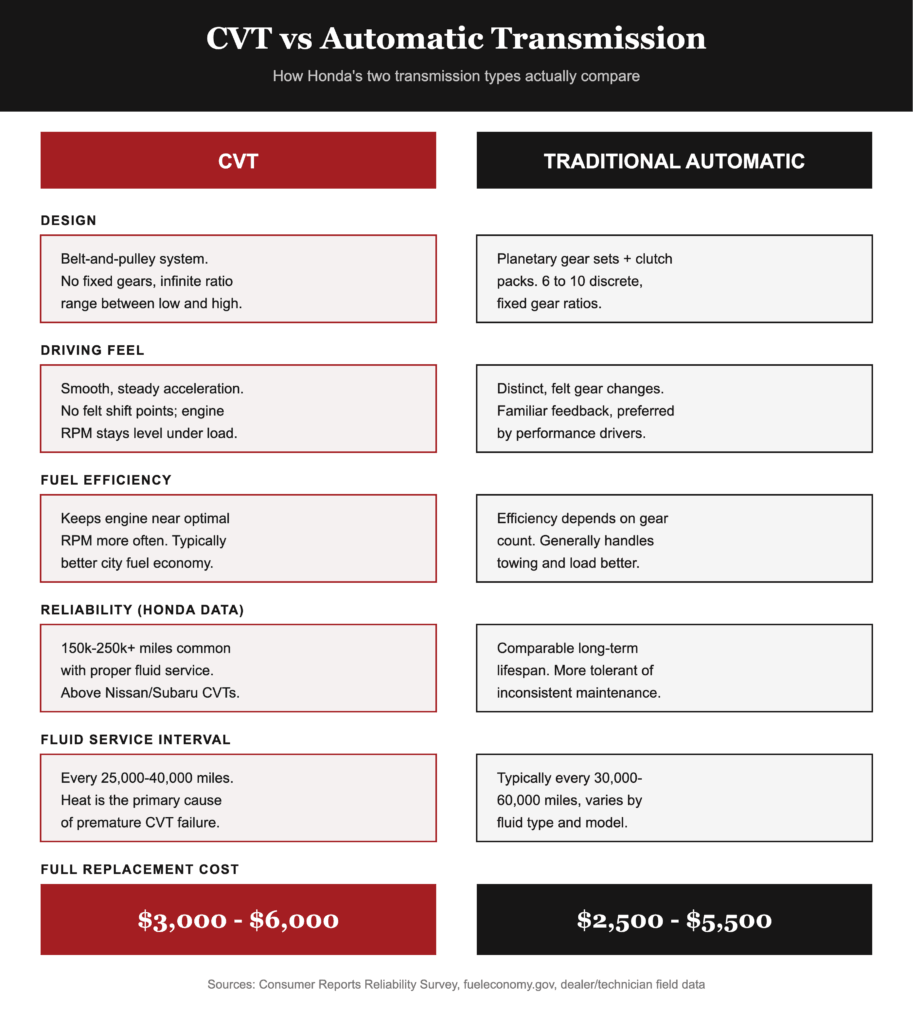
A continuously variable transmission has no fixed gears at all. Instead, it uses two cone-shaped pulleys connected by a steel belt or chain, and the pulleys widen or narrow to change the effective gear ratio on the fly. There’s no “1st gear” or “3rd gear” in the traditional sense, just an infinite range of ratios between the lowest and highest settings.
A conventional automatic transmission, by contrast, relies on planetary gear sets, clutch packs, and a torque converter to step through a fixed number of gears, typically six to ten in modern Honda applications. Each gear change is a discrete, mechanical event. You can feel it, even in a well-tuned automatic. A CVT skips that entirely, which is why acceleration in a CVT-equipped Civic feels like one long, smooth pull rather than a series of steps.
Honda has used CVTs across most of its mainstream lineup since roughly 2014, including the Civic, Accord, CR-V, and HR-V. The company’s engineers designed the system primarily around fuel economy and low-end responsiveness, not outright performance. That tradeoff matters. A CVT keeps the engine closer to its most efficient RPM range more often than a stepped automatic can, and that’s the whole point of the design.
Honda’s CVT reliability sits above most competitors but below Toyota’s conventional automatics, according to independent reliability surveys. That’s a specific, checkable claim, not marketing language. Consumer Reports’ annual reliability data has repeatedly placed Honda’s CVT-equipped models above the industry average, ahead of Nissan and Subaru’s CVT offerings, which have historically posted higher failure rates.
Longevity numbers back this up in the real world, too. Well-maintained Honda CVTs in the 2016 through 2022 Civic and CR-V generations regularly reach 150,000 to 250,000 miles. Some owners report passing 300,000 miles without a rebuild, though that’s the exception rather than the rule.
The catch is maintenance, and it’s a big one:
That last point is where the calculus gets interesting for a lot of owners. A remanufactured or quality used CVT assembly costs meaningfully less than a brand-new unit from the dealer, and it’s a legitimate option when the rest of the drivetrain is sound.
Drive a CVT and a stepped automatic back to back and the difference is obvious within the first hundred feet. The CVT holds the engine at a steady RPM under acceleration, which some drivers describe as a “rubber band” feeling, since road speed and engine noise don’t rise in lockstep the way they do with discrete gear changes. Honda has worked hard to reduce that sensation over the years by programming simulated shift points into the CVT’s control software, especially in the Accord and Civic Si-adjacent trims.
A traditional automatic, meanwhile, gives a more familiar sensation. You feel the gear changes. Enthusiasts tend to prefer this because it provides tactile feedback and, in performance applications, allows for more aggressive manual control through paddle shifters or sport modes.
On the efficiency side, the U.S. Department of Energy’s fueleconomy.gov overview of transmission technology notes that CVTs can improve fuel economy by keeping the engine operating near its optimal efficiency point across a wider range of driving conditions. That’s consistent with what Honda’s own EPA ratings show: CVT-equipped Civics and Accords generally post better city fuel economy than comparable stepped-automatic competitors in the same class.
Torque delivery is where the CVT shows its limits. Under heavy towing loads or repeated hard acceleration, the belt-and-pulley design generates more heat than a geared automatic, and heat is the primary enemy of CVT fluid life. This is exactly why Honda doesn’t offer CVTs on its heavier-duty applications like the Ridgeline or Pilot, which use a conventional 9 or 10-speed automatic instead.
Neither transmission type is inherently bad. That’s the honest answer, even if it’s not the satisfying one. A CVT rewards an owner who keeps up with fluid service and drives normally. A stepped automatic tolerates more abuse but weighs more, costs more to manufacture, and typically returns lower fuel economy in city driving.
If you’re shopping used, the transmission type shouldn’t be a dealbreaker on its own. What matters more is service history. Ask for CVTF change records. A CR-V with documented fluid changes at 30,000-mile intervals is a safer bet than a stepped-automatic vehicle with no maintenance records at all, regardless of which system sits under the hood.
A few practical checks before buying or continuing to drive a CVT-equipped Honda:
That last step catches problems before they become expensive ones. A CVT control module will often log a fault code long before the driver notices anything wrong.
If a CVT or conventional automatic does need to come out, the repair path usually comes down to three options: a new unit from the dealer, a remanufactured unit from a specialty shop, or a used, low-mileage assembly pulled from a donor vehicle. Each comes with its own price point and warranty terms, and it’s worth getting quotes across all three before committing. For owners comparing options, browsing used Honda drivetrain inventory alongside remanufactured quotes gives a clearer picture of what a fair repair actually costs.
The bottom line: a Honda CVT and a traditional automatic aren’t competing for the same job. One prioritizes efficiency and smoothness, the other prioritizes durability under load and a familiar driving feel. Know which one is under your hood, keep the fluid on schedule, and the transmission type stops being something to worry about.
A practical guide to buying a used Toyota Tacoma engine,...
How does a Honda CVT transmission compare to a traditional...

A breakdown of the most common Ford EcoBoost engine problems,...

A breakdown of 2025 Honda Pilot transmission problems, the 10-speed's...